
Dice odds describe the chance that a number, range, or total will appear after a roll. At Hawkplay, members can review these figures before choosing stakes in PHP or USD. This article serves players seeking clearer probability reading, accurate payout comparisons, and informed dice selections.
Basic meaning and range of dice odds
Dice odds show how often an outcome should occur across repeated independent rolls. Each result stays random, while possible faces create a fixed probability structure. Players can compare selections without treating recent results as signals for the next throw.
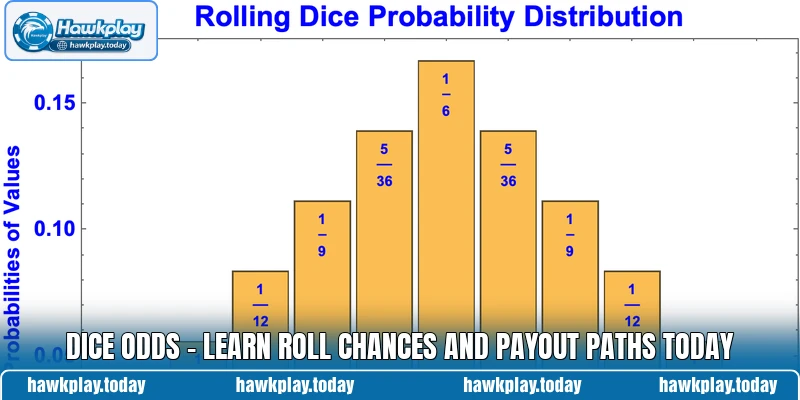
Dice odds change when a game uses two dice instead of one. A single die gives six equal outcomes, while paired dice create thirty six combinations. Totals near seven appear more often because several pairs can produce the same sum.
Dice odds matter because payout tables may not match the true mathematical chance. Hawkplay displays wager values in PHP or USD, allowing direct risk and return comparisons. Clear reading starts with combinations, then continues through payout ratios and stated house margins.
Core rules behind balanced dice probability results
Every dice market counts successful outcomes against all possible results. Players should read that ratio before comparing payouts or selecting a total.
Reading single roll chances
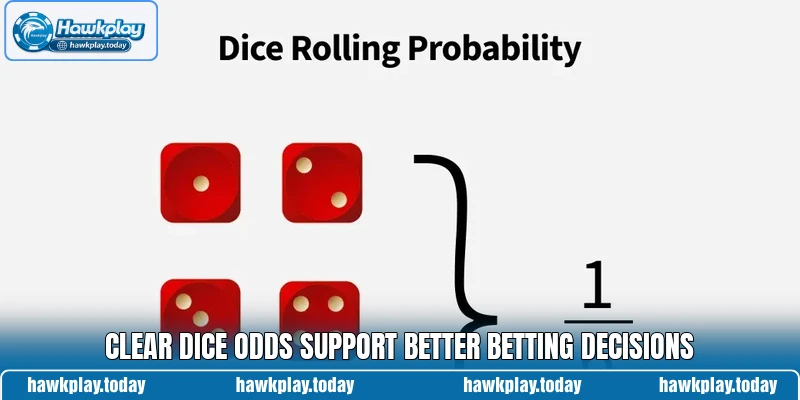
A standard six sided die gives each face one chance from six possible results. That fraction equals about 16.67 percent when every side has equal weight. Members can apply the same method to any clearly numbered die.
A wager covering two faces wins on two outcomes from six possibilities. Its basic chance becomes one third, or about 33.33 percent per roll. Wider coverage raises frequency, although the listed payout usually becomes smaller.
A wager on odd numbers covers one, three, and five across the set. This selection has three winning faces and three losing faces under fair conditions. Players should check whether special rules exclude any result from settlement.
Comparing common dice totals
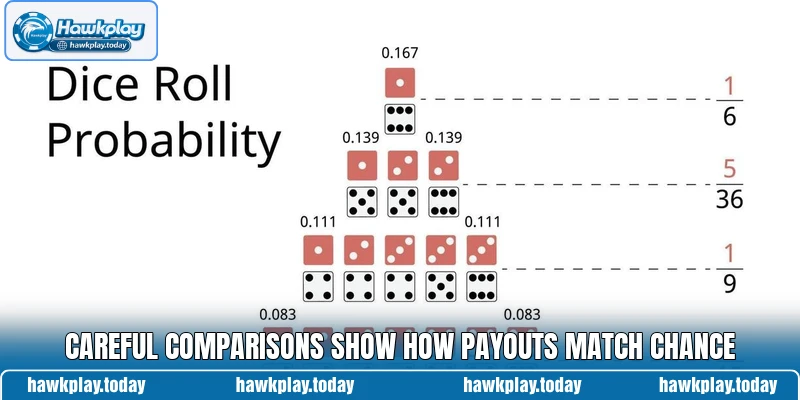
Two dice create totals from two through twelve, but they are not equally likely. Seven has six combinations, while two and twelve each have only one. This difference explains why middle totals often carry lower payout rates.
A total of six can appear through five distinct pairs during a fair throw. Those pairs are one five, two four, three three, four two, and five one. Its probability equals five divided by thirty six, or about 13.89 percent.
A total of ten has three possible pairs, so its natural frequency is lower. Including three six would be wrong because that pair produces a total of nine. Valid pairs are four six, five five, and six four.
Using dice odds tables
A clear table lists each selection, winning combinations, and all possible combinations. It may also show percentage chance, quoted payout, and resulting return. Members can compare rows without calculating every fraction during play.
Dice odds tables become clearer when percentages and fractional forms appear together. For example, one chance from six equals 1 to 6 and about 16.67 percent. Players should confirm whether displayed ratios describe probability, profit, or total return.
A payout marked 5 to 1 usually means five profit units for one staked. Total return may instead include both profit and the original stake. Reading the label prevents confusion when PHP 100 produces PHP 500 or PHP 600.
Checking payout versus probability
Fair payout value can be estimated by dividing one by the outcome probability. A 25 percent chance has fair decimal value near 4.00 before any margin. Actual returns may be lower because the operator includes a house advantage.
Dice odds provide probability, while the paytable provides the reward. Players need both figures because a frequent result can still offer weak value. A rare event may pay more, although its chance remains much smaller.
Suppose a selection wins once from six and pays 5.5 times total return. A PHP 100 stake would return PHP 550 when the original amount is included. Members should compare that value with the fair 6.00 decimal level.
Better ways to interpret betting outcomes clearly
Accurate comparison requires more than noticing whether a choice wins often. Members should connect combinations, payout terms, and settlement rules before placing wagers.
Separate chance from payout
Probability tells how often an event may occur, while payout states the reward. These measurements relate, but they do not express the same information. Players should not treat a larger payout as evidence of stronger winning likelihood.
A one face selection carries lower frequency than a three face choice. Its return should be higher because fewer results can produce a win. The exact difference depends on game rules and included margin.
Dice odds separate mathematical frequency from the amount shown beside each wager. Members can compare a PHP 50 choice with a USD 1 choice consistently. Currency changes the stake size, but not the underlying probability.
Study total arrangements carefully
Combination counting prevents errors when two dice create the same total differently. A result of eight has five ordered pairs, although some members count only three. Reversed pairs remain separate because each die can show a different face.
The pairs for eight are two six, three five, four four, five three, and six two. That produces five wins from thirty six equally likely paired outcomes. The percentage is about 13.89 percent under fair dice conditions.
Players should repeat this method for any total before trusting a visual impression. Written combinations make missing pairs easier to detect and remove unsupported guesses. They also clarify why nearby totals can have different payout values.
Compare house edge clearly
House edge measures the long term difference between fair value and offered return. It does not predict one roll or a short session result. Members can calculate it only when probability and payout information are available.
Dice odds create the starting probability, while quoted return completes the calculation. Multiplying chance by total return gives expected return before subtracting from one. A result of 0.97 implies an estimated house edge near three percent.
Different bets may carry different margins within the same dice table. Players should compare equal stake amounts in PHP or USD for accurate review. Clear settlement terms matter because pushes, ties, or exclusions change the final figure.
Conclusion
Dice odds give players a direct way to compare roll chances, combinations, and offered payouts. Hawkplay presents values in PHP or USD, supporting consistent reading across available wager sizes. Register, open the app, review every paytable carefully, and good luck with each roll.
